
Making Old NEPA Homes Work With Modern Power Needs
In older homes across Wilkes-Barre, Scranton, and the surrounding Luzerne County neighborhoods, one of the most common frustrations isn’t a major electrical failure—it’s something much simpler: not having outlets where life actually happens anymore.
A kitchen counter with no nearby plug. A living room where furniture placement is dictated by outlet locations. Bedrooms that rely on extension cords like they’re permanent fixtures.
It’s not unusual in older sections of Kingston, or in long-standing Scranton neighborhoods near streets like Green Ridge or Providence Road, to find homes that were built in a completely different electrical era—long before today’s device-heavy routines existed.
The good news is that correcting it doesn’t always mean opening walls from top to bottom.
Why Older Homes Were Never Built for Today’s Electrical Load
If you look at homes built several decades ago in NEPA, you start to see a pattern in how electricity was planned.
Back then:
- Rooms were designed around lighting, not devices
- Appliances were fewer and far less portable
- Extension cords were considered a normal solution
Fast forward to today, and even a single room might support:
- Charging stations for multiple devices
- Entertainment systems
- Air purifiers, fans, or space heaters
- Home office setups
Homes in areas like Shavertown or even hillside properties near the Back Mountain region often show this mismatch clearly—beautiful older construction, but limited electrical access where daily life now actually happens.
The Challenge: Adding Outlets Without Disrupting Finished Walls
In older homes, especially those with plaster walls or carefully finished woodwork, the biggest concern isn’t just electrical—it’s preservation.
Homeowners don’t just want more outlets. They want them without turning the house into a renovation project.
That usually means working within the structure rather than cutting into it heavily.
Common low-impact approaches include:
- Running wiring through basements or crawlspaces
- Using existing wall cavities with minimal access points
- Extending nearby circuits when capacity allows
- Strategic placement to avoid visible patchwork
In many NEPA homes, especially those built before modern wiring layouts became standardized, there’s often more access behind walls than homeowners expect—but it has to be approached carefully.
Clean Installation Methods That Respect Older Construction
Not every solution looks the same, and in older homes, flexibility matters.
Surface-Mounted Wiring (When Clean Matters More Than Hidden)
In homes where wall access is limited or preservation is a priority, surface-mounted raceways can provide a clean alternative.
They:
- Run discreetly along baseboards or corners
- Can be painted to blend into existing walls
- Avoid disturbing plaster or older finishes
- Allow future access without damage
It’s a practical option often used in homes where keeping original walls intact is just as important as adding functionality.
Working Through Existing Access Points
Many NEPA homes—especially those with basements or attic access—offer hidden pathways that make outlet additions less invasive than expected.
Instead of cutting through finished walls, wiring can often:
- Drop down from attic spaces
- Rise from basement runs
- Follow existing structural channels
This approach is especially useful in older homes around Wilkes-Barre Township or expanded properties that have been updated in stages over time.
When Adding an Outlet Reveals a Bigger Electrical Story
Sometimes, the request for “just one more outlet” opens the door to a larger discovery.
A few patterns that often come up:
- Circuits already running near capacity
- Breakers tripping when multiple devices are used
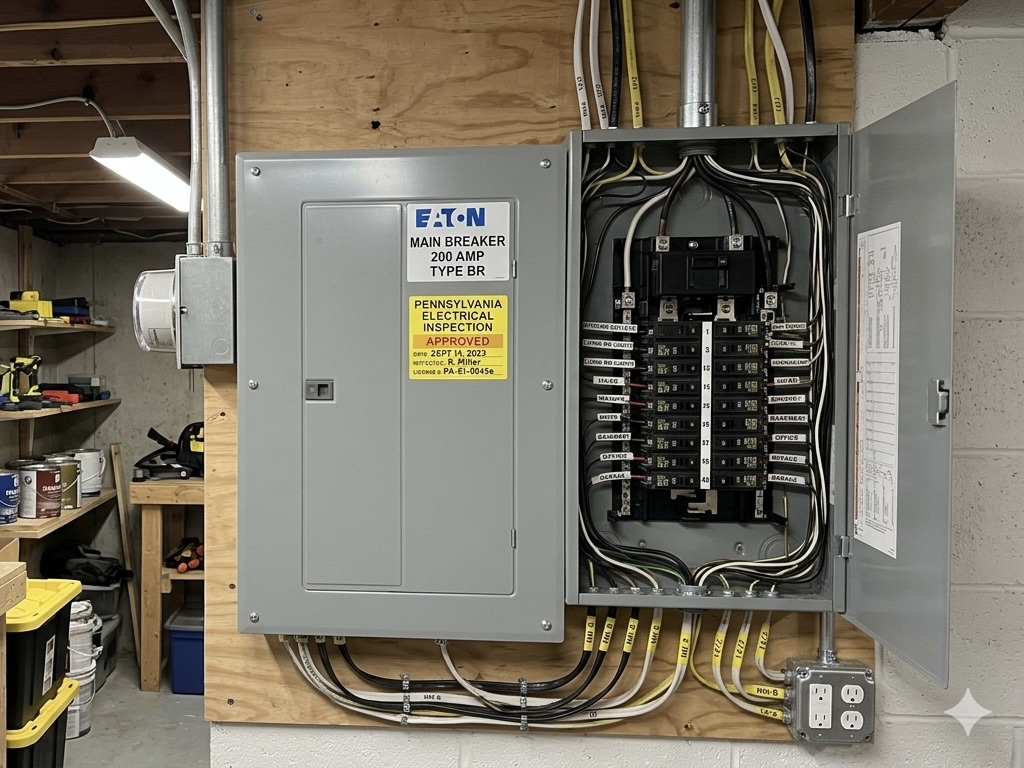
- Older panels with limited expansion space
- Mixed wiring from different renovation eras
It doesn’t always mean something is wrong—but it does mean the system is being asked to do more than it was originally designed for.
A Technical Insight: How Circuits Handle Added Load
When new outlets are added, they don’t just “exist” independently—they become part of a shared electrical load path.
Every circuit has a maximum safe amperage. When devices plugged into multiple outlets draw power simultaneously, the total current travels through the same conductor back to the panel.
If that combined load approaches the circuit’s limit:
- Voltage can fluctuate slightly under demand
- Breakers may trip as a protective response
- Wiring may experience increased thermal stress over time
This is why outlet placement isn’t just about convenience—it’s about how electrical load is distributed across the home’s system.
A Real NEPA Reality: Homes That Evolved in Layers
One of the most common traits in older homes across Scranton, Wilkes-Barre, and surrounding areas is that they didn’t evolve all at once.
Instead, they evolved in stages:
- Original construction
- Kitchen or bathroom remodels
- Basement finishing
- Appliance upgrades over time
Each stage added electrical demand, but not always in a fully integrated way.
So what you end up with is a home that functions well—but not always evenly when it comes to power distribution.
A Straight Answer to a Common Local Search Question
Can you add electrical outlets in older NEPA homes without tearing up walls?
Yes. In many homes across Wilkes-Barre and Scranton, outlets can be added using basement or attic wiring paths, existing circuit extensions, or surface-mounted raceway systems that avoid major wall demolition. The best method depends on the home’s structure, wiring age, and available circuit capacity.
When It’s Worth Taking a Closer Look
Not every home needs a full electrical rethink. But outlet additions tend to become more than just convenience upgrades when:
- Extension cords are used in multiple rooms daily
- Certain areas of the home feel “underpowered”
- Furniture placement is limited by outlet locations
- Renovations have changed how spaces are used
In older neighborhoods—from Kingston to Clarks Summit—it’s common for homes to simply outgrow their original outlet layout without the wiring ever being fully reassessed.
Living Comfortably in an Older Home Without Losing Its Character
There’s a balance that matters in NEPA homes.
You want modern convenience—but you don’t want to strip away the character or craftsmanship that makes older homes feel the way they do.
Outlet additions sit right in that middle space. Done thoughtfully, they don’t change the home’s identity—they simply make it easier to live in day to day.
And in homes that have already stood the test of time, that kind of upgrade is often less about change… and more about alignment.